
Tennis Total Games Betting: Over/Under Explained
 Available in US
Loading...
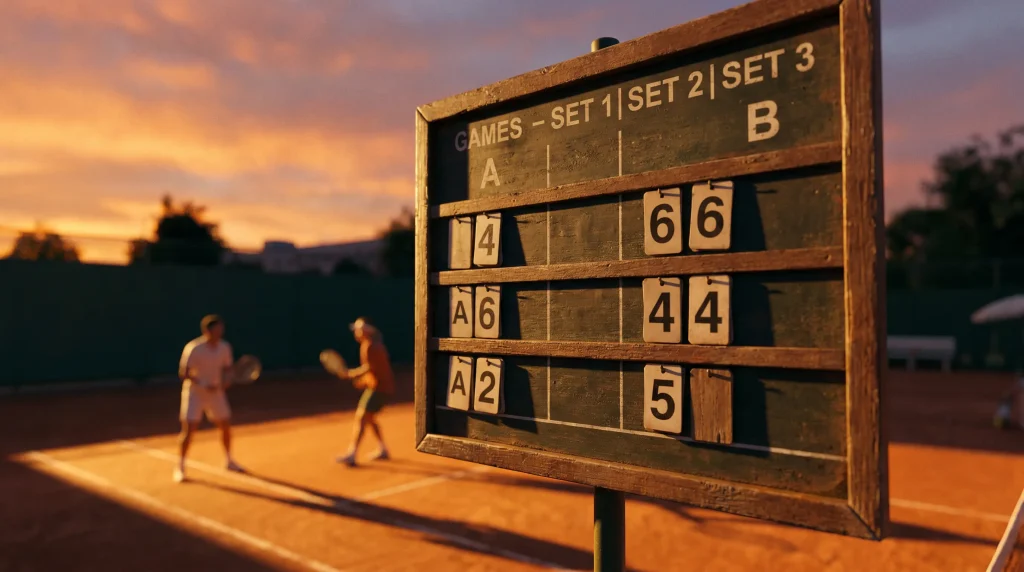
A bet that ignores who wins
The first time a friend told me he’d made money on a match without caring who won it, I assumed he was joking. He wasn’t; he’d bet the games total, and he’d correctly read that two big servers would grind out a long, break-light match regardless of which one prevailed. That’s the quiet appeal of the over/under games market: it frees you from the hardest question in betting, who wins, and replaces it with a more tractable one, how the match will flow.
The games total is, at heart, a bet on serve dominance. When both players hold serve comfortably, games pile up, sets reach tiebreaks, and the total climbs. When breaks come freely, sets end quickly and the total stays low. You’re not predicting a winner; you’re predicting the rhythm of the contest, the balance between serve and return across both players. Get that read right and the scoreline at the top of the market becomes irrelevant to your bet, which is a genuinely liberating way to approach a match you find hard to call.
What drives the games line
The bookmaker sets a games total by estimating how many games the match will contain, and that estimate is built almost entirely on expected hold rates. Two players who both hold serve at a high rate will produce long sets full of holds, pushing the total up. At the fastest events, where servers held close to 87.8% of their service games, matches naturally trend toward high game counts and frequent tiebreaks, and the totals line reflects that expectation before you even look at the names.

Surface is the single biggest driver of the line, because it shapes hold rates so powerfully. A fast hard or grass court, where serving dominates, lifts the expected games count and pushes the total higher. Slow clay, where returners get time to neutralise serves and breaks come more freely, pulls the total down because sets end sooner. The same two players will have a meaningfully different games line on clay than on a quick court, and the bookmaker bakes that surface effect straight into the number.

Format matters too, and it sets the ceiling. A best-of-five match simply contains more games than a best-of-three, so the totals line sits far higher at the men’s Slams, and the deciding-set tiebreak rules cap how high the final set can push it. Before I assess any games total, I read the surface, the format and the two players’ serving profiles together, because those three factors build the line, and understanding how they combine is how you judge whether the bookmaker’s number is too high or too low.
Hold-heavy versus break-prone matches
The cleanest way to think about a games total is to sort the match into one of two archetypes. A hold-heavy match features two strong servers who rarely get broken, producing long sets, frequent tiebreaks and a high games count. A break-prone match features weaker serving or excellent returning, where breaks come thick and fast, sets end quickly and the total stays low. Most matches sit somewhere on the spectrum between these poles, and placing them correctly is the heart of totals betting.

Reading the archetype requires looking past reputation to the actual serving and returning dynamics. Two players celebrated as big hitters might both be vulnerable on serve under pressure, making the match more break-prone than their reputations suggest and the over a trap. Conversely, two unheralded but solid servers on a quick court can produce a hold-heavy grind that sails over a line set too low by a market anchored to their modest profiles. The integrity dimension occasionally intrudes here too: totals markets on obscure matches have historically been a target for manipulation, though the picture has improved, with one integrity body noting that a quarter-on-quarter reduction in alerts was driven primarily by a welcome fall in tennis alerts in recent years. The cleaner the sport gets, the more a totals read reflects genuine tennis rather than something engineered.
The mechanics of serve hold that underpin all of this, how a hold rate translates into expected games and match shape, are worth understanding in depth, and I cover them fully in my piece on serve hold rates and break points. The games total is essentially a bet on the interaction of two hold rates across a match, so the better you understand hold, the better you read the total.
Reading and beating the total
Turning all this into a winning bet comes down to forming your own expectation of the games count and comparing it to the line. If you genuinely believe a match will be a hold-heavy serving contest, and the total looks low for that scenario, the over has value. If you read a break-prone slugfest and the total looks high, the under does. The discipline is the same as any value bet: bet only when your read diverges meaningfully from the market’s, not on every match where you have a vague feeling.

The traps are specific and worth naming. Surface mismatches catch people out, betting a clay-court total as if it were a grass-court one. Format confusion does too, applying best-of-three intuition to a best-of-five match. And the deciding-set tiebreak rule quietly caps the upper tail, so an over bet relying on a marathon final set is fighting a rule designed to prevent exactly that. Tiebreaks themselves count toward the games line in the standard way a single game does, which matters when you’re estimating a hold-heavy match likely to feature several of them.
So the games total rewards a particular kind of punter: one who enjoys reading the texture of a match rather than picking winners, who understands serve and surface deeply, and who can place a match on the hold-heavy to break-prone spectrum with confidence. It’s a market where you can profit from being right about how a match unfolds even when you’d never have backed either player to win it. For anyone who finds picking winners frustrating but loves understanding why matches play out as they do, the over/under games line is the most natural home in tennis betting.
Articles
Written by the editors at AceEdge.
