
Tennis Betting Markets Explained: From Match Winner to Game Handicaps
 Available in US
Loading...

Choosing a market is choosing which edge you are buying
A reader once asked me which tennis market was “the best one”, and I gave the answer that always disappoints people: there isn’t one. The question is like asking which tool in a workshop is the best tool. A chisel is useless for tightening a bolt. The market you pick is not a matter of taste or excitement — it is a decision about exactly what kind of advantage you think you have, and whether the price on offer pays you fairly for that advantage.
That framing matters because every market carries a different built-in margin, and every market rewards a different read of a match. The match-winner market is asking one question; the game handicap is asking a completely different one; the totals market does not care who wins at all. When the affiliate guides list these markets like items on a menu — moneyline, spreads, totals, futures, tick, tick, tick — they miss the only thing that matters, which is that each one is a separate bet on a separate piece of information, with its own pricing and its own trap doors.
So this is not a glossary. This is a guide to which advantage each market lets you cash in, where the bookmaker’s margin is thickest, and which type of bettor each market actually suits. The overround — the bookmaker’s built-in margin, the amount by which the implied probabilities of all outcomes add up to more than 100% — is the silent tax on everything you do, and it is not the same across markets. I will walk through the match winner, set and game handicaps, totals, and the more exotic score and prop markets, and for each one I will tell you the mechanic, show you how it grades, and name the mistake I see most often. By the end you should be choosing markets deliberately, not by habit.

The match winner: simple to understand, ruthless to beat
Let me start with a confession. The match-winner market — back a player to win the match, two outcomes, no draw in tennis — is where I have made the most money and also where I see beginners donate the most. It is the simplest market in the sport and the most ruthlessly efficient, and those two facts are connected. Because it is simple, everyone bets it, and heavy betting volume sharpens the price. The match-winner line on a big match is some of the tightest pricing you will find anywhere in tennis.
The two-way structure makes the maths clean. Convert both decimal prices to implied probabilities, add them up, and the amount over 100% is the overround you are fighting. On a heavily traded match this margin is often slimmer than on obscure markets, which sounds like good news and is — but a tight margin on an efficient price is not an opportunity, it is just a fair fight with a small handicap against you. The edge in the match-winner market comes from one place: knowing the true probability better than the crowd does, then finding the match where the price has drifted away from that truth.
The match winner is also the gateway to the part of the market that has grown most explosively: live, in-play betting, which now accounts for the majority of online sports betting turnover — recent market data put it at around 62% of the online market and still growing at a double-digit annual rate. In tennis, the point-by-point structure makes the match-winner price swing violently in-running on every break and hold, and much of the in-play action is simply the same two-way market re-priced after each game. Mastering the pre-match match winner is the foundation for everything that happens live, which is why I treat it as the market to understand before any other.
This is where one of the most durable facts in betting research earns its keep. Tennis markets show a favourite–longshot bias: longshots are systematically overbet relative to their true chance of winning, while heavy favourites are underbet. The practical consequence is that backing big favourites has historically offered the least-bad expected value, because the crowd’s love of a long price has nudged underdogs to artificially short odds and favourites to artificially generous ones. That does not mean blindly backing every favourite — the margin still eats you alive if you do that — but it does mean the popular instinct to “take a chance on the underdog for the bigger payout” is, on average, exactly backwards.
The mistake I see constantly in the match-winner market is treating the price as a prediction rather than a probability. People back the favourite because they think the favourite will win, full stop. But the favourite winning is already baked into the price. Your job is not to predict the winner; it is to judge whether the price overstates or understates how often that winner actually comes through. A favourite at a price that implies an 80% chance when you have honestly assessed them at 85% is a bet. The same favourite at a price implying 90% is a pass, even though you still expect them to win. The match winner is simple. Beating it is not.

Set handicaps: buying a head start, or insuring against an upset
The set handicap is the market that taught me to read the small print, because it is where the grading rules quietly decide whether you win or lose. A set handicap adjusts the result by a number of sets before settling. The two most common lines in a best-of-three match are minus 1.5 sets on the favourite and plus 1.5 sets on the underdog, and understanding exactly what each requires is the difference between a smart bet and a blind one.
Minus 1.5 sets on the favourite means they must win the match two sets to love. A single dropped set, even in a comfortable win, settles the bet as a loss. You are not betting that the favourite wins — you are betting that they win without stumbling, and that is a meaningfully harder thing. Plus 1.5 sets on the underdog is the mirror image: it pays out if your player wins the match outright or loses it having taken at least one set. It is, in effect, an insurance bet — you are covered unless your player is swept aside in straight sets.
The grading is clean because tennis sets cannot be drawn and there is no push on a 1.5 line, which is one reason I like the set handicap as a teaching market. But the pricing trap is real. On a heavy favourite, the minus 1.5 line can look temptingly bigger than the match-winner price, and the buzz of that bigger number lures people in without thinking about how often even dominant players drop a set. On the surfaces that breed volatility — slow clay, fast grass — even a strong favourite drops sets they would never drop on a true hard court, and the minus 1.5 bettor pays for that every time.
The set handicap is a class of market rather than a single bet, and the plus 1.5 line in particular deserves a full worked example of when the insurance is worth its cost. I have broken down exactly that — the cover, the price, and when it earns its keep — in my piece on what plus 1.5 sets means in tennis betting. For now, hold onto the core idea: the set handicap lets you buy a head start or buy insurance, and the price you pay for either should be judged against how often the favourite really wins cleanly, not against how attractive the bigger number looks.
Game handicaps: the market the tiebreak loves to ruin
If the set handicap is about whole sets, the game handicap zooms in on the granular battle of individual service games, and it is where I have watched more bets die on the final point than anywhere else. A game handicap, sometimes called a game spread, adjusts the total games won by each player. A favourite at minus 4.5 games must win, across the whole match, by at least five more games than their opponent. The underdog at plus 4.5 games keeps the bet alive as long as they stay within four games of the favourite, regardless of who actually wins.
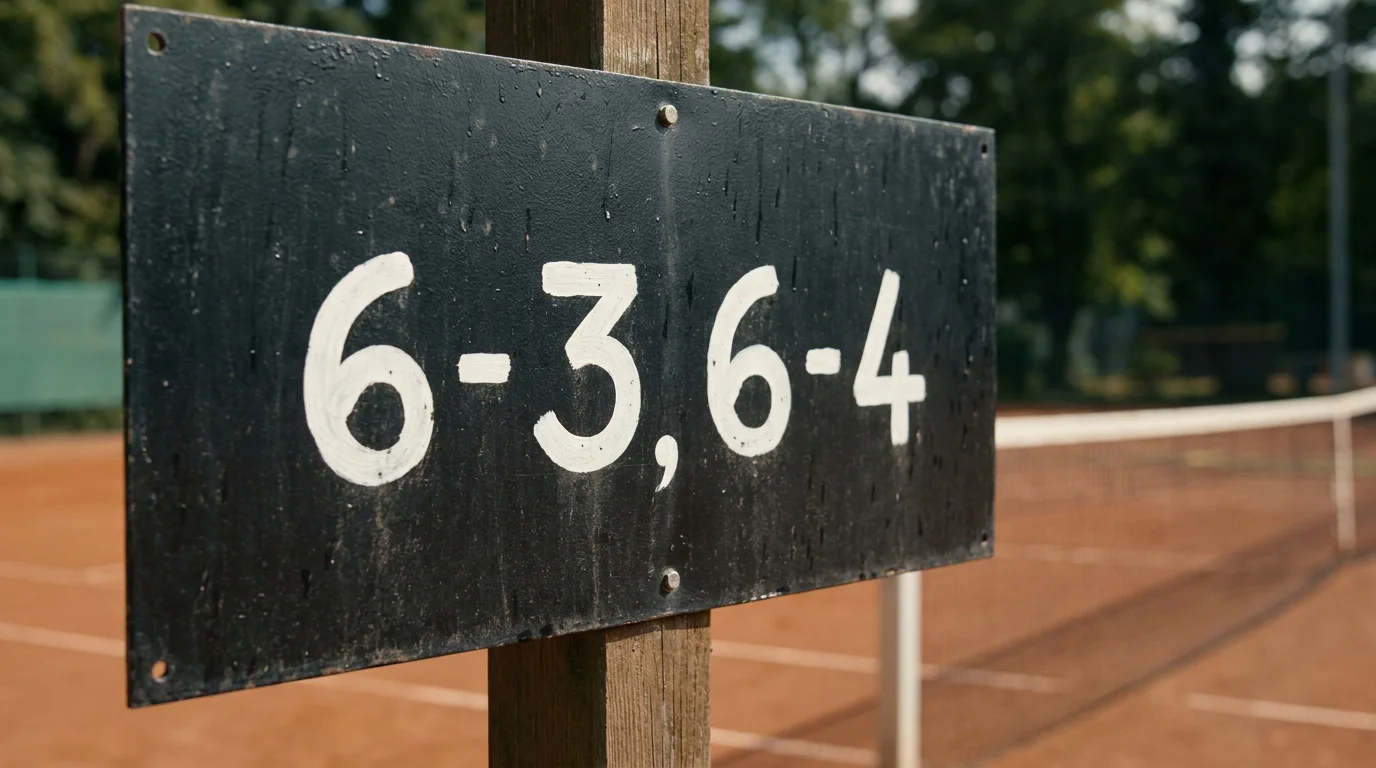
This market rewards a very specific read: not who wins, but by how much. A favourite who wins comfortably 6-2, 6-3 covers a minus 4.5 handsomely — that is a seven-game margin. A favourite who wins two tight sets, 7-6, 7-5, wins the match but only by three games, and the minus 4.5 backer loses. Same winner, opposite result for the handicap bettor. The skill is in judging the likely texture of the win, and that texture is driven heavily by serve dominance and surface, the very things I weigh before any bet.
The grading question people ask most is how a tiebreak counts, because it does not award the seven games the score might suggest. A set won 7-6 in a tiebreak counts as seven games to six for handicap purposes — the tiebreak itself adds a single game to the winner’s total, not the full margin of the breaker. That one rule has decided countless bets I have been involved in. On serve-dominated surfaces where tiebreaks are common, game handicaps become genuinely treacherous, because a player can dominate on serve, win two tiebreaks, take the match, and still fail to cover a modest game spread.

My rule with game handicaps is to bet them only when I have a strong view on the match’s texture, not just its winner. On a slow surface where breaks come freely, a superior player can run up a lopsided game margin, and the favourite handicap can be the value play. On a fast surface where holds are routine and tiebreaks loom, I lean towards the underdog’s plus line, because the favourite’s superiority struggles to translate into a wide game margin when so many games go with serve. The game handicap is a precision instrument. Used without a clear read on how the match will flow, it is just an expensive way to be right about the winner and wrong about the bet.
Totals: betting the shape of the match, not the result
Totals are my favourite market for one liberating reason — you can be completely wrong about who wins and still cash. The total games market sets a line for the combined number of games in the match, and you bet whether the real number lands over or under it. Who lifts the trophy is irrelevant. What matters is the shape of the contest: tight and grinding, or one-sided and brief.
The line is driven almost entirely by serve and surface. Two big servers on a fast court will hold relentlessly, push sets to tiebreaks, and rack up a high game count — that profile pushes the total up. A favourite expected to break early and often against a weak server on a slow court points towards a low total, because the match ends in fewer, more decisive games. The surface effect here is measurable, not vague: first-serve effectiveness runs at roughly 67.5% on hard court against about 62.4% on clay for the men’s tour, and that handful of percentage points feeds directly into how many games a match is likely to produce. When I price a total, I am not thinking about names at all; I am thinking about expected hold rates, the likelihood of tiebreaks, and whether the match projects as a serve-fest or a break-fest.
There is genuine strategic depth here — reading which players push the line up, which drag it down, and how surface shifts the whole calculation — and it goes well beyond a single section. I have written a dedicated piece on the full strategy of tennis total games over/under for anyone who wants to trade this market seriously. In this overview, the essential point is that totals decouple your bet from the result, which makes them perfect when you have a strong read on the texture of a match but a weak read on its winner — a situation that comes up far more often than beginners expect.

One pricing note worth carrying forward: totals markets are less heavily traded than the match winner, which can mean a slightly fatter margin but also slower-moving, less efficient lines — and inefficiency is where edges live. The trade-off is that you must do your own work on the serve-and-surface profile, because the crowd is not doing it for you the way it does on the headline market.
Correct set score, props and the lure of the long price
Now for the markets that pay the bookmaker’s mortgage. Correct set score — predicting the exact set scoreline, such as two sets to nil or two sets to one — and the broader family of prop bets carry the longest odds in tennis and, not coincidentally, the thickest margins. I bet them rarely and always with my eyes open, because the gap between the headline price and the fair price is wider here than anywhere else in the sport.
The appeal is obvious and the trap is exactly that appeal. A correct-set-score price of, say, a healthy multiple of your stake looks enormously more attractive than the short match-winner odds on the same favourite. But you are now being asked to predict not just the winner but the precise manner of victory, and the number of possible outcomes the bookmaker can load margin into has multiplied. The implied probabilities across all the set-score lines add up to a far heavier overround than the clean two-way match-winner market. You are paying a premium for the bigger number, and over time that premium is a tax you cannot beat with prediction alone.
Props — markets like whether a tiebreak will be played, total aces, or a specific player to win a particular set — share the same character. They can be genuinely fun and, occasionally, genuinely soft, because they are thinly traded and the bookmaker is sometimes pricing them with less care than the headline markets. That thinness is the only real opportunity here: a prop nobody is betting can carry a lazy price. But the margins are wide by default, so the bar for finding value is correspondingly high.
This is also the territory where the wider industry makes its money on combination bets. Accumulators and combined markets carry far heavier holds than straight singles — in some major markets combination products such as parlays have made up around 22% of total turnover, with an average hold exceeding 15%, far above the margin on single bets. The lesson transfers cleanly to tennis: every extra leg, every extra layer of specificity in a correct-set-score or prop bet, hands the bookmaker another slice of margin. My discipline here is simple. I treat correct set scores and props as occasional, low-stake plays reserved for the rare moment I spot a genuinely soft, thinly traded line — never as a staple, and never as a way to chase a bigger number for its own sake.

Matching the market to the bettor you actually are
After years of doing this, the single most useful thing I can tell a newer bettor is that the right market depends less on the match than on you — your edge, your temperament and your honest assessment of what you actually know. The tennis betting market has been reshaped enormously by the move online, and as the American Gaming Association’s research lead David Forman has observed, the revenue picture “looks very different than it used to” now that more people than ever have access to more bet types than ever. More markets does not mean more opportunity for everyone. It means more ways to be matched, or mismatched, to the bet that suits you.
If you are new and your edge is mostly judgement about who is better, stay on the match winner. It is the most efficient market, yes, but efficiency protects beginners as much as it constrains them — there are no exotic traps, the maths is transparent, and the favourite–longshot bias quietly rewards the disciplined backing of strong favourites over the seductive chasing of underdogs. Master the discipline of judging price against true probability here before you go anywhere near the wider markets.
If your edge is reading the texture of a match — serve dominance, surface effects, whether a contest will be tight or lopsided — then totals and game handicaps are your natural home, because they pay you for exactly that read and free you from having to call the winner. As VSiN’s analyst Gill Alexander likes to remind people, winning at tennis “isn’t just about luck”, and the texture markets reward precisely the kind of analytical work that separates skill from chance.
And if you are tempted by the long prices of correct set scores, props and combinations, be honest about whether you are seeking value or seeking a thrill. There is no shame in the occasional small-stake punt for entertainment, but do not confuse it with edge. The bettor who lasts is the one who picks the market that matches their genuine advantage, accepts the margin that comes with it, and ignores the markets that promise more excitement than expected value. Choose the tool that fits the job and your own hand — that, more than any single tip, is what keeps a bankroll alive.
Articles
Written by the editors at AceEdge.
