
How to Bet on Tennis and Win: A Working Analyst's Guide
 Available in US
Loading...

Most people who ask how to bet on tennis and win are really asking the wrong question. They want to know how to pick the winner of a match, and tennis hands them a tidy two-horse race that feels pickable. But picking winners and making money are different sports. The punter who turns a profit over a season is not the one who guesses the most correct results. He is the one who keeps buying odds that are longer than the true chance of the outcome, match after match, until the maths does its work.

I have spent nine years building surface-adjusted models, pulling apart ATP, WTA and Challenger prices, and watching where the soft numbers live. The single most useful thing I can tell you on day one is this: your opponent is not Sinner or Sabalenka. Your opponent is the price. Every bookmaker builds an overround into the odds — a margin baked into the line that guarantees the book turns a profit if money lands evenly. Beat the player and lose to the overround, and you still go home poorer. The whole game is finding the small number of prices where the market has the chance wrong by more than the margin it charges you.
That is what “value” means, and it is the only thing that separates a winning approach from an expensive hobby. A heavy favourite at a fair price can be a brilliant bet; a glamorous underdog at a terrible price is a donation. Neither has anything to do with how much you like the player. Tennis happens to be one of the better sports for this, partly because it generates an enormous volume of matches and markets, and partly because attention clusters on a handful of stars while hundreds of lower-tour matches get priced by algorithms running thin. Inefficiency hides in the gaps.
Here is the honest framing before we go further. This is not a system that prints money. The bookmaker’s margin is widening year on year, not shrinking, so to win you have to clear an edge that grows every season and stay disciplined when variance is punishing you. What follows is the toolkit: how odds and overround work, which markets give a punter a real shout, how surface and serve move the fair price, how to spot value, how to stake without going broke, and why the integrity picture matters more than the tipster feeds admit.
Start with the question almost every guide skips and every honest punter asks first — whether there is any money in this at all.
What This Guide Settles Before You Place a Bet
- Winning at tennis means backing prices longer than the true chance, not predicting winners. Your real opponent is the bookmaker’s overround, not the player.
- The national hold has risen to about 9.3%, so the margin you must beat grows every year. Stake flat or fractional, never chase, and treat bankroll as the engine.
- Surface is measurable, not mood: first-serve effectiveness runs roughly 62% on clay against 67-68% on hard, which shifts fair odds before you read a single preview.
- Integrity is a live issue — tennis drew 58 of the 219 suspicious-betting alerts logged across all sports in 2024 — so where you bet and which tiers you trust both matter.
Edge comes from price discipline and surface-adjusted reading, not from confidence in a result. Find value, stake sensibly, and let volume do the work.
Is There Actually Money in Tennis Betting
A friend who codes for a hedge fund once asked me why I bothered with tennis when the bookmakers have more data and faster computers than I ever will. Fair question. They are not trying to beat me — they are trying to balance their book and bank the margin. That gap between what they need and what I need is the only room I have to work in, and it is narrower every season.
Yes, you can make money. No, most people don’t. Both things are true at once, and any guide that tells you only the first half is selling you something. The handicapper Gill Alexander put the mindset plainly when he said winning at tennis isn’t just about luck — which sounds obvious until you notice how many punters bet as though it is exactly that, reloading on a hunch and calling a losing month bad variance.
The margin you are fighting. The national sportsbook hold — the percentage of all staked money operators keep after paying out winners — climbed to roughly 9.3% in 2024, up from 9.1% in 2023 and just 6.7% in 2018. That is the headwind. If the average bet you place carries a built-in 9% disadvantage, you have to be right often enough, at long enough prices, to claw back that margin and then some before you see a penny of profit.
So where does the edge come from? Mostly from a quirk of human behaviour that academics have documented for decades. Tennis betting markets show a favourite-longshot bias: punters systematically overbet longshots relative to their true probability, chasing the fat payout, which means heavy favourites are routinely underbet and therefore offer the least-bad expected value on the board. This isn’t folklore — it was formalised in the research literature, Forrest and McHale in 2007 then Lahvička in 2014, across large samples of matches. The crowd loves a romantic upset, the price on the upset gets too short, and the unglamorous favourite quietly becomes the smarter buy.
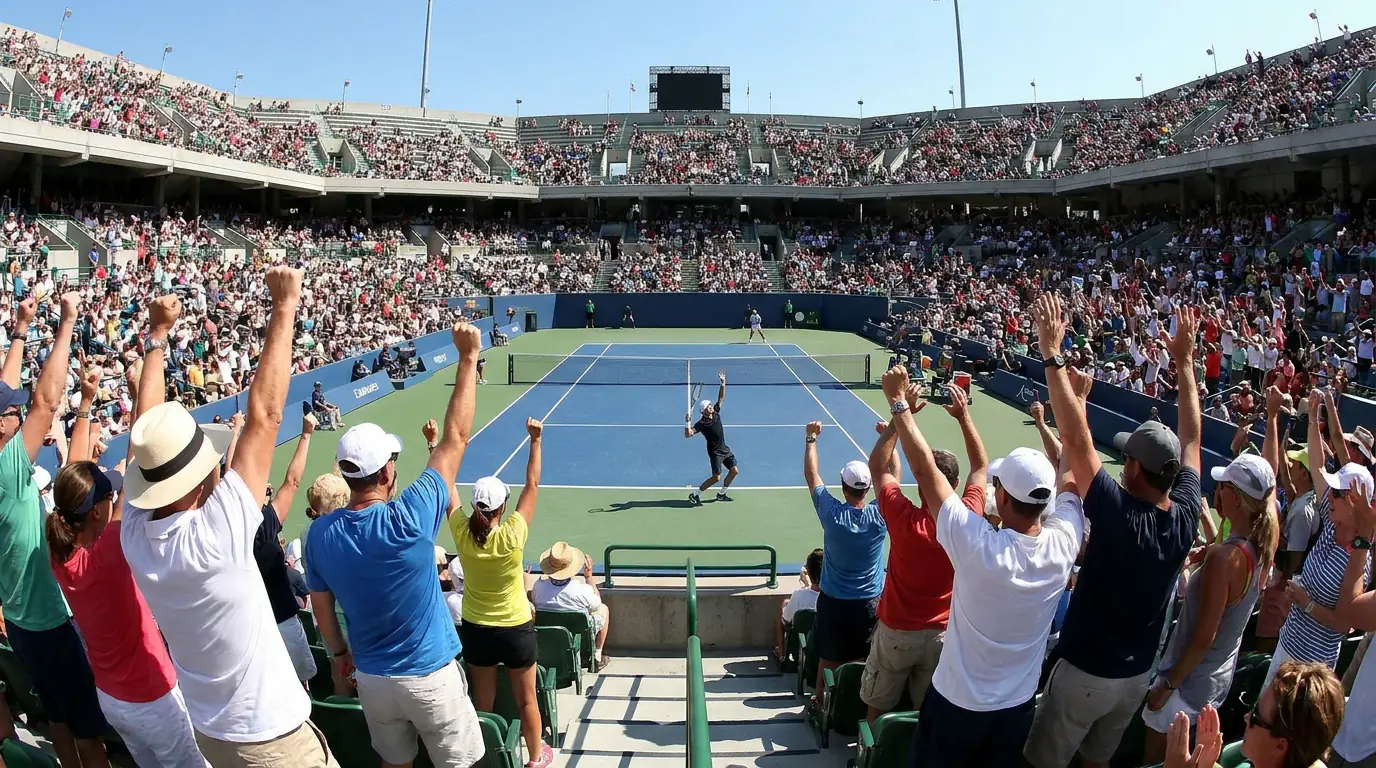
That single insight reframes the whole enterprise. The profitable punter is usually backing boring outcomes at honest prices, not hunting heroic upsets. The money is in patience, not flair. And the edge is thin: realistic long-term yields for a sharp tennis bettor sit in low single-digit percentages of turnover, not the doubling-your-bank fantasy the tipster channels peddle. A 3-4% yield over thousands of bets is a strong result, which also means a bad run of fifty bets tells you almost nothing.
If your plan relies on a high strike rate — picking the right player most of the time — you have already lost. A 40% strike rate at consistently good prices beats a 60% strike rate at bad ones. Track the price you got against the price the market closed at, not whether the bet won.
The honest verdict: tennis is one of the more beatable sports for a disciplined punter, precisely because of its volume, its star-driven attention bias and the soft pricing on lower tours. But “beatable” and “easy” are not synonyms. The operators posting that 9.3% hold are not running a charity, and the widening of that figure tells you they are getting better at this, not worse.
How Tennis Odds Actually Work
Decimal odds of 1.50 are not a prediction that a player wins two times in three. They are an instruction: stake one pound, collect one pound fifty if you are right. The implied probability is the reciprocal — 1 divided by 1.50, which is 66.7%. Learn to do that conversion in your head and you have the single most important skill in betting, because it lets you translate any price into the chance the bookmaker is asking you to accept.
UK punters meet odds in two dresses. Fractional odds — 8/13, 5/4, evens — read as profit relative to stake: 5/4 means stake four to win five. Decimal odds, now standard on every exchange and most apps, fold your stake into the return, so that same 5/4 is 2.25 in decimal. Most analysts work in decimal because the implied-probability sum falls out cleanly and comparing 1.91 with 1.95 is far easier than squinting at 10/11 versus 20/21.
Decimal to implied probability.
Price 1.50 implies 1 / 1.50 = 66.7%.
Price 2.50 implies 1 / 2.50 = 40.0%.
Price 3.40 implies 1 / 3.40 = 29.4%.
Fractional 5/4 = 2.25 decimal, which implies 1 / 2.25 = 44.4%.
Here is where most casual bettors never look. Add up the implied probabilities of every outcome in a market and they should total 100%. They never do. In a two-way match you might see the favourite at 1.40 and the underdog at 3.00, implying 71.4% and 33.3% — a sum of 104.7%, not 100%. The extra 4.7 percentage points are the bookmaker’s margin, and that surplus has a name.
Overround — the amount by which the implied probabilities in a market exceed 100%. It is the bookmaker’s built-in margin, sometimes called the vig or juice. An overround of 104.7% means the book is charging you 4.7% on top of true odds; the lower the overround, the fairer the market and the more room a sharp punter has to find value.

Overround is why “back the favourite, they usually win” is a losing plan on its own. If the favourite’s true chance is 71% but the price only pays as though it were 71.4%, you are paying full whack with no margin in your favour. To profit you need the genuine probability to sit meaningfully above the implied one — the favourite’s real chance must be 75% when the price implies 71%. That gap, and only that gap, is your edge.
Margins vary enormously by market, and that variation is a map of where to hunt. Headline match-winner markets on a Grand Slam final are fiercely competitive, with overrounds sometimes squeezed to 102% because every operator wants the action and smart money sharpens the price. Obscure props on a Challenger match can carry overrounds of 115% or worse, because the book knows few people price those accurately. As a rule, the more exotic and lightly traded the market, the fatter the margin, and the harder you have to be right to overcome it.
This is also why betting exchanges deserve a mention. On an exchange you bet against other punters rather than the house, paying a commission on winnings instead of an embedded overround, and you can lay an outcome — bet on it not to happen — as well as back it. The effective margin on a liquid exchange market can be a fraction of a bookmaker’s, which is why many operators restrict the accounts of consistent winners while exchanges let them keep playing. None of this matters, though, until you can read a price and instantly know the chance it implies.
The Markets Where a Punter Has a Real Shout
Walk into any tennis match page and you will face thirty or forty markets before the first serve. New punters treat that menu like a buffet and load a plate from every tray. That instinct is precisely backwards. Choosing a market is choosing which kind of edge you are buying, and most of those trays exist to separate you from your money.
Think of the markets in three broad families. The first is the match outcome — who wins. The second is the handicap family, where you bet on margin rather than result: set and game handicaps that level a mismatch by spotting one player a head start or a deficit. The third is totals and props — over or under a number of games, exact set scores, tiebreak markets, aces. Each family asks a different question, carries a different margin, and rewards a different kind of knowledge.
Match winner
Back a player to win the match. Tightest margins, deepest liquidity, hardest to find soft prices because everyone is watching. Your edge comes from disagreeing with the crowd on probability, not from an obscure angle.
Set and game handicaps
Bet on the winning margin rather than the winner. A -1.5 set handicap needs your player to win in straight sets; a +5.5 game handicap gives an underdog a cushion. These reward punters who can read how lopsided a match will be.
Totals over and under
Bet on the number of games landing above or below a line. Driven by serve strength and surface far more than by who wins. Hold-heavy match-ups push totals up; break-prone clay grinds them down.
Props and exotics
Correct set score, total aces, tiebreak in the match. The fattest margins on the board and the thinnest liquidity. Occasionally a genuine value pocket; far more often a trap dressed as a treat.
Then there is the dimension that has reshaped the whole business: when you bet. Pre-match is the traditional form, but live or in-play betting now dominates — it accounted for 62.35% of the online sports betting market in 2024 and is still growing, and tennis is its natural home. The pauses between points, the momentum swings, the way a single break resets the price all make it ideal for a market that updates ball by ball. The opportunity is real, because models pricing a fast-moving match can lag a human watching closely. So is the danger: live markets are built to tempt you into more bets, faster, with less thought, and the overround on an in-play price is often wider than the same market pre-match.
| Characteristic | Match winner | Handicaps | Totals and props |
|---|---|---|---|
| Typical margin | Lowest | Moderate | Highest |
| Liquidity | Deepest | Good on main tours | Thin, especially lower tiers |
| Main driver | Overall strength | Expected margin | Serve, surface, format |
| Edge source | Probability disagreement | Reading one-sidedness | Pricing serve and conditions |
| Beginner risk | Low | Medium | High |
If you are starting out, live on the match-winner and handicap markets and treat the exotics as occasional, well-researched exceptions. The handicaps in particular reward genuine analysis: a player who is a near-certainty to win but might drop a set is far better value at +1.5 sets than at a cramped match-winner price. That kind of distinction turns a thin edge into a usable one, and it is the territory of my full guide to the tennis betting markets and how each one is graded, which walks through grading, pushes and edge cases market by market. For the pillar the point is simpler: pick fewer markets, understand them properly, and treat margin as the first thing you check, not the last.

Why Surface Moves the Price Before You Read a Word
The first time I built a model that adjusted for surface, my hit rate on totals jumped overnight, and I felt like an idiot for not doing it sooner. Surface is the most underpriced public information in tennis. Everybody nods along to “surface matters,” then bets as though clay and grass are the same game in different colours. They are not. They are measurably different sports, and the difference shows up in the one number that drives almost everything: how often serve is held.
Start with the serve. First-serve effectiveness runs at roughly 62.4% on clay, 64.2% on grass and 67.5% on hard court for the men’s game, and the women’s tour shows the same ordering, around 62% on clay rising to 67-68% on hard. That five-to-ten-point swing sounds modest. On a tennis scoreboard it is enormous. A server who wins a few more first-serve points holds more often, faces fewer break points, and turns matches into tighter, serve-dominated affairs with more games and fewer upsets. Slow clay does the opposite: it neutralises big serving, lengthens rallies, rewards the grinder and breeds breaks.
Clay
First serve ~62%. Slowest surface, most breaks, longest rallies, fewest cheap holds. Rewards stamina and consistency.
Grass
First serve ~64%. Fast, low bounce, serve-friendly, short points. Most upset-prone over a season.
Hard
First serve ~67-68%. Servers dominate most; on the quickest indoor events hold rates climb toward 88%.
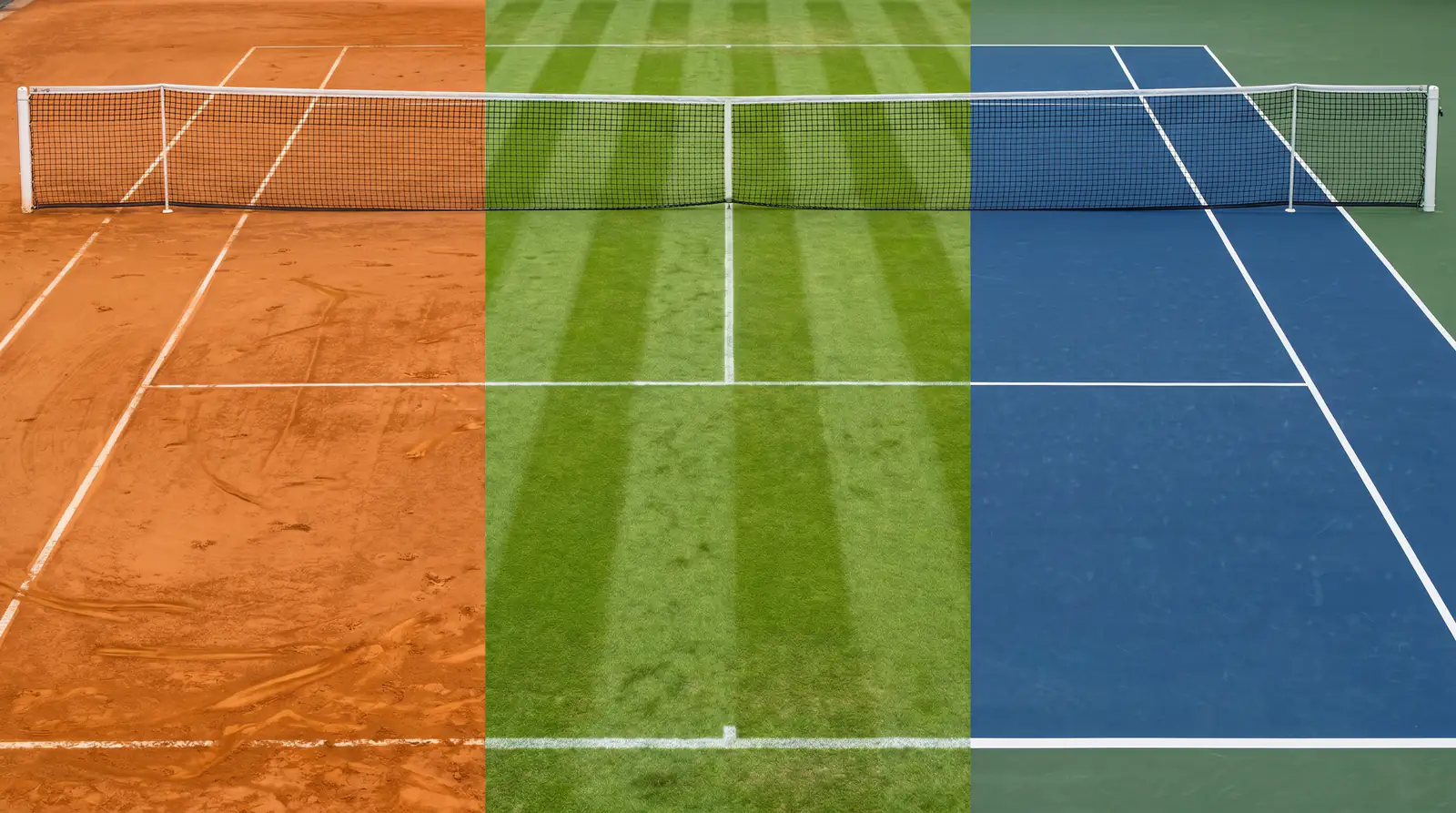
That last figure is worth sitting with. On the fastest indoor-hard event of the calendar, the season-ending championship in Turin, servers have held around 87.8% of their service games and won roughly 77.3% of first-serve points. Hold that high turns a match into near-automatic service games punctuated by the rare break, which is why totals on fast indoor courts sit so much higher. Drop the same two players onto slow clay and the maths inverts: holds get harder, breaks multiply, and the underdog’s path to a set widens.
Surface specialisation can reach almost cartoonish extremes. Across 2011 to 2020, Rafael Nadal posted a clay win rate of 90.98%, while over the same era Novak Djokovic won 88.38% of his hard-court matches. Djokovic is the only man in the Open Era to hold career win rates of at least 80% on all three surfaces. When a player is that surface-skewed, the market sometimes prices their reputation rather than the court under their feet.
For a punter, the practical takeaway is that surface should shift your fair price before you have read a single preview. A baseline grinder meeting a big server is a different bet on clay than on grass, and the market does not always move far enough to reflect that. The specialists are the obvious cases; the subtler money is in the journeyman whose game quietly suits one surface and whose price barely moves between tournaments.
There is a further layer most punters miss: not all courts of the same type play at the same speed. A hard court in Shanghai can play markedly quicker than one in Miami, and that intra-surface variance moves serve numbers as much as the broad clay-grass-hard split does. That is its own discipline, and I have laid out how to read court speed and conditions within a single surface in the breakdown of how court surface decides tennis bets across clay, grass and hard. For the pillar, hold onto the headline: surface is a number, the number is hold of serve, and the market underreacts to it more often than it should.
Finding Value Without Fooling Yourself
Value is the most abused word in betting. Every tipster claims to find it; almost none can define it without waving their hands. So let me be exact. A value bet exists when your honest estimate of an outcome’s probability is higher than the probability implied by the price. Nothing else qualifies — not a strong feeling, not a player “due” a win, not a tip from a mate who watched the warm-up. If your number beats the bookmaker’s number, you have value. If it doesn’t, you have a punt.
The whole craft comes down to producing a probability estimate you can trust, then comparing it honestly to the implied price. The honest part is harder than the maths, because the temptation is always to nudge your estimate until it justifies the bet you already wanted to make. Set your number first, then look at the price.
A simple value check.
Suppose your model says a player has a 60% chance to win a match. The fair price for 60% is 1 / 0.60 = 1.67.
The bookmaker is offering 1.91 on that player. The implied probability of 1.91 is 1 / 1.91 = 52.4%.
You believe the true chance is 60% but the market is treating it as 52.4%. That gap is your edge.
Expected value per pound staked: (0.60 * 0.91) – (0.40 * 1) = 0.546 – 0.40 = +0.146, or roughly 14.6% per pound. That is a clear value bet, provided your 60% is honest.

Notice the whole thing hinges on that “provided.” Garbage in, garbage out. If your 60% is wishful thinking dressed as analysis, the positive expected value is imaginary and you will bleed slowly. This is why the best value hunters spend most of their effort on the estimate, not the search, and why they obsess over closing line value as a reality check. If the price you took keeps beating the price the market settles at by kick-off, your estimates are genuinely ahead of the crowd.
Where mispricing hides. Value clusters where attention distorts the price. One striking study tracked Wikipedia page views before more than ten thousand singles matches and found that “buzz” — the surge of public attention on a player relative to the opponent — significantly predicted bookmaker mispricing. Betting the higher-buzz player against the field produced substantial simulated profit, because the crowd’s attention dragged the price away from the true chance. Hype is not just noise; it is a measurable, exploitable distortion.
That research points at the practical hunting grounds. Value lives wherever the crowd is loud and the data is quiet: a returning star whose name still commands a short price after a long layoff, an unfashionable player on their best surface against a bigger name, a lower-tour match the public barely looks at. It rarely lives in the headline market of a Grand Slam final, where every sharp in the world has already squeezed the margin flat.
A word of caution the tipster feeds will never give you. Finding one value bet is easy and almost meaningless. Finding value repeatably, sizing it correctly and surviving the variance is the entire job — and the deeper mechanics of building estimates, measuring closing line value and grinding an edge over a season belong in the full treatment of value betting in tennis and how to find a genuine edge. For now, anchor on the definition: your honest probability versus the implied price. Everything else is decoration.
Staking: The Part That Actually Keeps You Solvent
I have watched genuinely sharp punters go broke. Not because they couldn’t find value — they could — but because they staked like the next bet was the last one that would ever matter. Edge without staking discipline is a sports car with no brakes. You can have the best probability estimates on the circuit and still blow up, because the order in which wins and losses arrive is random and a long losing run arrives eventually. Staking is how you survive it.
The foundation is the unit: a fixed, small fraction of your bankroll that you treat as one standard bet. Most disciplined punters set a unit at 1-2% of bankroll. With a bankroll of one thousand pounds, a unit is ten to twenty pounds, and your bets cluster around that size regardless of how strongly you fancy a match. This is flat staking, and its virtue is that it makes ruin almost impossible from variance alone — a long losing streak at 2% a time costs a manageable chunk, not your stake.
Flat staking under a losing run.
Bankroll: 1,000. Unit at 2%: 20 per bet.
You hit a brutal run and lose ten in a row. Total down: 200, leaving 800. Painful, survivable.
Now imagine you had staked 20% per bet instead — 200 a time. The same ten-loss run wipes you out before the run even ends.
Same edge, same bad luck, two entirely different outcomes. The only variable was stake size.

There is a more aggressive approach, the Kelly criterion, which sizes each bet in proportion to your edge and your odds, staking more when the value is larger. Used in full it is mathematically optimal for growth and emotionally unbearable, because it demands large swings and assumes your edge estimate is exact, which it never is. Most professionals who use it run a fraction — a quarter or a half Kelly — to soften the volatility and protect against their own overconfidence. That is its own subject, and I have walked through the staking maths in detail in the guide to tennis bankroll management and how to size your stakes.
Do
- Set a unit at 1-2% of bankroll and keep bets near it.
- Decide your stake before you look at the price, then check for value.
- Recalculate your unit only on a fixed schedule, not after every win.
- Track every bet, including the price you took and the closing price.
Don’t
- Chase losses by doubling up to win it back in one bet.
- Stake more because you are “certain” — certainty is a feeling, not data.
- Bet money you need for anything that matters in real life.
- Confuse a winning week with a working method, or a losing one with a broken one.
The unglamorous truth is that staking discipline does more for most punters’ bottom line than any improvement in their picks. It is the part nobody wants to hear and the part that separates people still betting in five years from those who flamed out in five months. Find your edge, size it like an adult, and let a large number of small bets do the compounding.
How Big the Tennis Betting Machine Really Is
Provocative question to start: why should a punter care how large the betting market is? Because size tells you where the soft prices live. A market that is enormous, growing fast and increasingly automated has gaps — too many events, too many prices, not enough sharp attention to keep every line honest. Scale is opportunity, if you know where to look.
The numbers are vast. The global sports betting market reached roughly 107.4 billion US dollars in 2024 and is forecast to grow at about 9.3% a year toward 261 billion by 2034. The online slice alone sat near 42.5 billion in 2024 and is projected to push past 68 billion within a decade. This is not a cottage industry with a few mispriced corners; it is one of the fastest-scaling consumer markets on earth, and operators are pouring resources into pricing it tighter every season.
107.4bn
Global sports betting market in 2024, forecast to reach about 261bn by 2034 at roughly 9.3% a year.
42.5bn
Global online sports betting in 2024, on track to top 68bn within ten years.
13.83%
Projected annual growth rate of tennis betting through 2031 — the fastest-growing sport in the online market.
~7%
Tennis share of global sports betting revenue in 2024, with in-play wagering especially popular.

Tennis sits in a sweet spot within all that growth. It is projected to be the fastest-growing sport in online betting, expanding at a 13.83% annual rate through 2031, and the reason is structural rather than faddish. Grand Slams span time zones and run for a fortnight, the sport produces a near-continuous calendar across multiple tours, and every point is a natural betting moment. That makes tennis the ideal vehicle for in-play betting, and the tours have leaned in — ATP and WTA struck data partnerships in 2024 and 2026 to embed official feeds into platforms, cutting latency and expanding the point-by-point markets on offer.
For the punter, the lesson hidden in these figures is about the distribution of attention. The handle concentrates on a small number of marquee matches, but the number of matches priced keeps exploding. Operators cannot staff every Challenger and ITF event with sharp traders, so those lines lean on models running with thin information — and that is precisely where a diligent punter with a surface-adjusted view can find prices the market has not bothered to sharpen. The giants are not interested in a hundred-pound bet on a second-round qualifier nobody is watching, and that indifference is your opening. Bigness, properly understood, is not intimidating. It is a map of where the operators are paying attention and, more usefully, where they are not.
The Integrity Problem the Tipsters Won’t Mention
Here is something you will not find in a single promotional betting guide: tennis has a fixing problem, and pretending otherwise costs punters money. I am not being lurid — the sport’s own integrity bodies publish the figures, and they are sobering. In 2024 the International Betting Integrity Association logged 219 suspicious betting alerts across all sports, and tennis accounted for 58 of them, second only to football. Together those two sports made up over 60% of every alert raised. If you bet tennis seriously, you are operating in one of the two most-flagged sports on the planet.
The good news is that the structure for catching it has matured. The International Tennis Integrity Agency investigates alerts and hands down real sanctions: in a single quarter of 2024 it sanctioned or suspended ten individuals for betting-related violations, including lifetime bans, and enforcement has only intensified since. This is not a sport ignoring the problem — it is one actively policing it, and that record is part of why the integrity picture, while serious, is not hopeless.
Suspicious betting alert — a flag raised by an integrity monitor when wagering patterns on a match deviate sharply from what the odds would predict. An alert is a trigger for investigation, not a verdict; many have innocent explanations.
That distinction matters enormously, and the integrity bodies are at pains to make it. As the ITIA has repeatedly stressed, an alert on its own is not evidence of match-fixing; where the analysis of a flagged match does suggest corrupt activity, the agency conducts a full and confidential investigation before any conclusion. Unusual betting can spring from incorrect odds-setting, well-informed money, a player’s hidden injury or fatigue, or simple playing conditions. The alert is smoke. Sometimes there is fire; often there is not.
The geography of the problem is shifting too. Khalid Ali, who heads the IBIA, has described the focus of suspicious betting as “remaining primarily on football and tennis,” while noting a geographical shift away from European events that is, in his words, too early to call a settled trend. For a punter, the takeaway is not panic but awareness: the risk concentrates in the lower tiers, where prize money is thin, scrutiny is lighter and the temptation to manipulate a result is highest.
Practical defence for an ordinary punter: be wary of obscure lower-tour matches where the price moves violently for no visible reason, especially in markets a fixer could control — a specific game, a single set. If a line lurches and you cannot explain why from form, surface or news, that is not your value bet calling; that is a reason to walk away. The matches most vulnerable to manipulation are almost never the ones worth your stake.

None of this should frighten you off the sport. The overwhelming majority of matches are clean, the marquee events are watched too closely to fix, and the monitoring is better resourced than ever. But “is tennis betting safe” is a fair question with a real answer: safe enough on the main tours, riskier the further down you go, and worth understanding before you chase a suspiciously generous price. I have set out the alert system, the famous cases and how to read a tainted market in the piece on tennis match-fixing and how integrity monitoring actually works.
The Mistakes That Quietly Drain Your Bank
Most losing punters do not lose because of one catastrophic decision. They lose by a thousand small, repeated errors that each feel reasonable in the moment. I have made every one of them. The mistakes are not exotic — they are boring, human and almost universal, and recognising yourself in them is the first edge most people ever gain.
The biggest is betting too many matches. The urge to have action on everything is the enemy of value, because value is rare and scattered, not present in every fixture on the slate. There is also the tyranny of the favourite — backing short prices because they win often, ignoring that they win often precisely because they are short, with no margin left for you. And there is recency bias: a player wins a tournament, the price on their next match overcorrects, and the crowd piles in just as the value evaporates. Form, as one betting editorial put it, can swing quickly due to fatigue, injury or momentum shifts across tournaments, which is exactly why last week’s result is a treacherous guide to this week’s price.
Do
- Pass on matches where you cannot identify a clear edge.
- Weigh schedule and fatigue, not just the last result.
- Judge a bet by the price you got, not whether it won.
- Keep records honest enough to show you your own leaks.
Don’t
- Bet a match just because it is on and you are bored.
- Back a favourite purely because they usually win.
- Overreact to a single big win or shock loss.
- Pile into the in-play markets without a pre-set plan.
Then there is the most expensive mistake of all, the one that turns a manageable bad week into a wipeout: chasing. A run of losses triggers the urge to win it all back with one big, badly-reasoned bet, and that single decision undoes months of discipline. Variance is not a debt the next bet has to repay. The only correct response is to keep staking exactly as you planned. The punter who can lose ten in a row and place bet eleven at the same size, on the same logic, has already beaten most of the field.

Nearly every long-term loss is self-inflicted: too many bets, too much faith in favourites, too little record-keeping, and chasing. Fix those four and you have done more for your bottom line than any tipping service ever will.
Run Through This Before Every Stake
Pilots use checklists not because they are forgetful but because the cost of skipping a step is too high to trust to memory. A betting checklist works the same way. It is not about distrust of your judgement; it is about catching the lapse in discipline that happens precisely when a match excites you and you most want to skip straight to the stake.
This is the routine I run before every bet, in this order, every time. It takes under a minute once it becomes habit, and it has talked me out of more bad bets than any model ever has.
Before you confirm the stake
- Have I set my own probability for this outcome before looking at the price?
- Does my probability beat the implied probability of the offered odds, with room to spare over the overround?
- Have I accounted for surface — does this match-up favour the server or the grinder, and has the price moved enough to reflect it?
- Have I checked schedule and fatigue, recent travel, and whether either player has a hidden physical issue?
- Is the stake within my unit, sized by plan rather than by how strongly I fancy it?
- Can I explain any sharp line movement from form, surface or news — and if I cannot, am I walking away?
- Am I betting this because there is value, or because I want action?
If a bet fails any single one of those questions, it does not get placed. Not at a smaller stake, not “just this once” — it does not get placed. The discipline is binary, because the moment you allow exceptions the checklist stops protecting you. Most of the time the routine confirms what you already knew and you bet with a clear head. Occasionally it stops you cold, and those are the moments that pay for the whole exercise. The single most profitable habit in betting is the willingness to not bet, and a checklist turns that willingness from a good intention into a reflex.

Questions Punters Ask Me Most
After nine years I get the same handful of questions — at dinner parties, in DMs, from friends who have just lost a tenner and want to know where it went. Here are the straight answers, the ones I would give over a coffee rather than in a sales pitch.
None of what follows is a promise that you will win. It is the honest mechanics. Tennis betting can be beaten by a disciplined punter, but it sits inside a global market worth over 107 billion a year for a reason — the operators win far more often than the players do.
Is it possible to make money betting on tennis?
Yes, but it is hard and rare. Profit comes from consistently backing prices longer than the true chance, not from picking winners, and you have to clear a bookmaker margin that has risen to around 9.3%. A genuinely sharp punter might earn a low single-digit percentage yield on turnover over thousands of bets. Most people lose, mainly through poor discipline rather than bad luck.
What is the best bet type for tennis?
There is no single best market — there is the market that suits what you know. Match-winner markets have the tightest margins and deepest liquidity. Handicaps reward punters who can read how one-sided a match will be. Totals hinge on serve and surface. Beginners do best on match-winner and handicap markets and should treat the exotic props as occasional exceptions.
How do tennis betting odds work?
Decimal odds tell you the total return per pound staked: 1.91 returns 1.91 including your stake. The implied probability is 1 divided by the price, so 1.91 implies about 52.4%. Add up the implied probabilities across a market and the surplus over 100% is the bookmaker’s overround — the margin you must overcome to profit.
Does court surface really change who I should back?
Measurably, yes. First-serve effectiveness runs about 62% on clay against 67-68% on hard, which means servers dominate more on quick surfaces and breaks multiply on slow clay. A big server is a stronger bet on grass or fast hard; a grinder is better value on clay. Surface should shift your fair price before you read anything else about the match.
What is a set handicap in tennis betting?
It is a bet on the winning margin in sets rather than the result. A -1.5 set handicap needs your player to win without dropping a set; a +1.5 handicap pays out as long as your player wins at least one set, even in defeat. It lets you back a strong favourite at a better price, or give a likely loser a cushion, depending on how lopsided you expect the match to be.
How much of my bankroll should I stake per match?
Keep each bet to a small fixed fraction of your bankroll — most disciplined punters use 1 to 2% per bet as a unit. On a 1,000 bankroll that is 10 to 20 a match. Staking flat means a long losing run dents you rather than ruins you, and it removes the temptation to bet bigger when you feel certain, since certainty is a feeling, not data.
Is tennis betting safe, and are matches fixed?
The main tours are safe enough and watched far too closely to fix. Tennis does draw a high share of suspicious-betting alerts — 58 of the 219 logged across all sports in 2024 — but an alert is an invitation to investigate, not proof, and most have innocent explanations. The real risk concentrates in obscure lower-tier matches. Stick to well-watched events, walk away from inexplicable line moves, and only ever bet through a licensed operator.
Keeping the Edge Without Losing the Plot
I will end where every honest guide should. Everything in these pages assumes you are betting money you can afford to lose, for an edge you have earned through work, with a head clear enough to walk away. The moment any of that stops being true, the strategy stops mattering, because no amount of value betting survives a punter who has lost control of the why and the how much.
Betting is now woven into ordinary life. Around one in five adults placed a sports bet in the past year, and roughly four in five online bets are now placed on a phone, which means the bookmaker is in your pocket every waking hour, frictionless and always open. That convenience is what makes discipline harder and the warning signs worth knowing: betting more than you intended, chasing losses, hiding the extent of it, or feeling you need a bet to enjoy watching. If any of that sounds familiar, the analytical edge is no longer the point.
Betting is for adults aged 18 and over. When the fun stops, stop. If gambling stops feeling like a choice, free and confidential help is available in the UK through GamCare, the self-exclusion scheme GAMSTOP, and BeGambleAware. Setting deposit limits, time-outs and reality checks within your account takes seconds and protects everything else.

Treat that as the foundation the rest is built on, not a footnote. The punters who are still in the game years from now are the ones who kept it a game — disciplined with their stakes, honest with their records, and quicker than anyone to recognise when it was time to step back. The edge is worth having. It is never worth more than your control over it.
Articles
Created by the "AceEdge" editorial team.
