
How In-Play Tennis Betting Works
 Available in US
Loading...

Why tennis is the in-play sport
The first time I traded a match live, I backed a player at 2.40, watched him win three points, and saw the same selection collapse to 1.70 before I’d put my coffee down. That swing, in under ninety seconds, taught me more about in-play tennis than any guide ever did. The price wasn’t reacting to whether he’d win. It was reacting to whether he’d hold the next service game.
Tennis dominates live betting for a structural reason: the game pauses constantly. Live and in-play wagering now makes up roughly 62% of the entire online sports betting market, and tennis is one of the engines behind that figure because its scoring is a ladder of discrete, bettable moments. Every point ends, every game ends, every set ends, and between each of those the market reprices. Football gives you ninety minutes of one drifting number. Tennis gives you a fresh question every thirty seconds.

What you are really doing in-play is not betting on the result during the match. You are trading the volatility of a scoring system where a single break of serve can move the win probability by twenty points or more. Understand that and you stop chasing the scoreboard and start reading the price.
Why prices swing so violently live
Picture a man serving at 4-4, 30-30 in a deciding set. He misses a first serve, the crowd tightens, and the live price on his opponent shortens before the second serve even lands. That is the market pricing a single point as if it were a hinge, because in tennis it often is.

The mechanics behind these swings come down to leverage. In a sport where the better player wins maybe 55% of points but 80% of matches, individual points carry enormous weight near the margins. Break points, set points and deciding-set tiebreaks are the high-leverage moments, and the price reflects that leverage in real time. A break of serve at the right moment can swing an implied win probability from 60% to 80% in the space of four points, which is why the number you see lurches rather than drifts.
The official tour data feeds matter enormously here. The ATP and WTA struck partnerships with betting operators across 2024 and 2026 to embed official point-by-point data directly into platforms, cutting latency and expanding the menu of live bet types. That sounds like back-office plumbing, but it shapes your experience directly: the faster and cleaner the data, the tighter the suspensions and the more granular the markets. It also means the bookmaker is rarely working from worse information than you are.
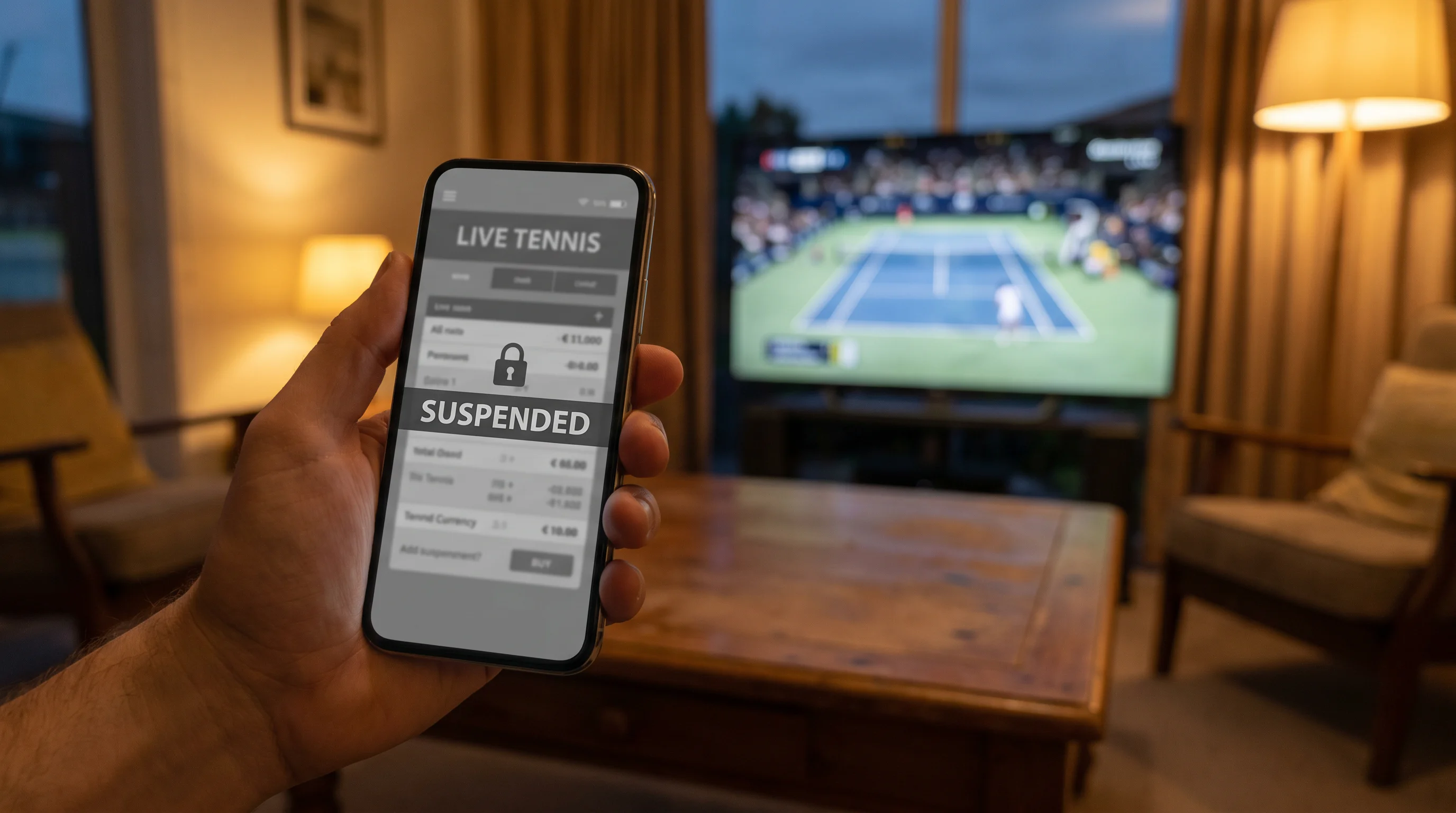
Suspensions are the part newcomers find maddening. The market freezes at break point, at set point, between points sometimes, and you cannot get a bet on at the very moment you most want one. That is not the bookmaker being awkward. It is the bookmaker protecting itself during the seconds when the price is most uncertain and most likely to be wrong, and it is your clearest signal that you have identified a genuinely pivotal moment.
Reading momentum without inventing it
Momentum is the most overused word in live tennis and the most misunderstood. I’ve watched punters pile into a player who just won a flashy game, convinced the tide had turned, only to see the favourite hold to love and restore order. The crowd felt momentum. The price felt a temporary mispricing, and it corrected.

Real, bettable momentum in tennis is almost always tied to serve. If a player’s first-serve percentage has collapsed, or they’ve been broken twice in a set, the underlying mechanics have genuinely shifted and the price should follow. If they’ve simply won a dramatic rally or two, that is theatre, not information. The discipline is separating the points that change the structure of the match from the points that merely change the mood in the arena.
My working rule is to anchor every live read to a serving question. Can the favourite still hold comfortably? Is the underdog’s second serve being attacked? Has fatigue started to show in the length of rallies they’re willing to play? Answer those and you have a reason to act. React to a single highlight and you are donating to the bookmaker. The deeper version of this thinking, applied to the most volatile phase of a match, runs through my breakdown of the third-set live betting system, which examines whether the popular decider strategy actually survives contact with the margin.
There is also a psychological trap worth naming. Live markets are designed to feel urgent, with prices ticking and the action unfolding in front of you, and that urgency pushes people into volume they never intended. I’ve seen disciplined pre-match bettors lose their heads the moment they switch to live, firing on five points in a row because the screen kept inviting them to. The cure is to decide before the match what live scenarios you would actually bet, write them down, and refuse anything outside that list no matter how tempting the lurching number looks.
Latency, feeds and the lag you cannot beat
Here is the uncomfortable truth that every live bettor learns the hard way. If you are watching on a television broadcast, you are behind. Broadcast signals run several seconds behind the live court, and the bookmaker is pricing off a low-latency data feed, not your screen. By the time you see the ace, the price has already moved, and you are effectively betting on the past.

This gap is why so-called courtsiders once existed, people physically at the venue relaying scores faster than the broadcast. The official tour feeds have largely closed that loophole for operators, but the lesson for a recreational punter stands: never bet a live point off a delayed broadcast as though your information is current. It isn’t. You are reacting to a result the market has already absorbed.

The practical defence is to stop trying to win the speed race you cannot win. Instead of betting on what just happened, bet on what you expect to happen over the next few games, where your read of serve quality and stamina gives you a genuine opinion the price might not yet hold. That is the only version of live tennis betting where a recreational player has a fighting chance.
Articles
Written by the editors at AceEdge.
